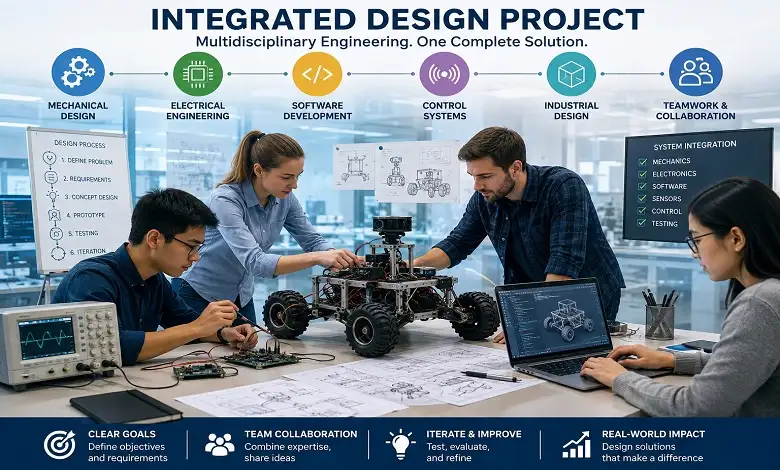
An integrated design project combines various engineering and design disciplines to create a comprehensive, functional solution to a real-world problem. Rather than treating mechanical, electrical, software, and other engineering disciplines as separate activities, an integrated approach requires them to work together from the early stages of planning through testing and final delivery.
This approach has become increasingly important because modern products and systems are rarely based on one discipline alone. A robot, electric vehicle, automated machine, smart building, or industrial system may require mechanical components, electronics, sensors, software, control systems, and user-focused design to function properly.
Universities are increasingly using project-based and multidisciplinary design education to provide students with experience in these real-world conditions. For example, UCL’s Integrated Engineering Programme incorporates project-based design into undergraduate engineering education, while the University of Tennessee’s Integrated Engineering Design program has students design, build, and test real products or systems in multidisciplinary teams.
What Is an Integrated Design Project?
An integrated design project is a structured project in which people from different technical disciplines collaborate to design, develop, test, and improve a product, system, or solution.
The word “integrated” is important. The objective is not simply to place several specialists on the same team. Their work must interact.
For example, consider an automated robot. The mechanical team may design its frame and moving mechanism, the electrical team may develop the circuits and power system, while the software team creates the control logic. The robot will only work effectively if these individual elements are compatible.
Therefore, an integrated design project considers the entire system, rather than evaluating each component in isolation.
The University of Colorado Boulder describes integrated design as a process based on highly collaborative, multidisciplinary teamwork and consideration of all aspects of an engineering project. (
Why Is Integrated Design Important?
Engineering problems are becoming increasingly interconnected. A modern product may depend on hardware, software, automation, data, materials, energy efficiency, safety, and human interaction at the same time.
A traditional approach in which each discipline works separately can create communication gaps. One team may make a technically sound decision that creates a problem for another team.
Integrated design attempts to reduce these conflicts by encouraging collaboration throughout development.
It can help teams:
- Identify technical problems earlier
- Improve communication between specialists
- Understand system-level requirements
- Reduce incompatible design decisions
- Develop practical problem-solving skills
- Test concepts before final production
- Improve product reliability
- Build stronger teamwork and project-management abilities
Research and educational programs in multidisciplinary engineering similarly emphasize teamwork, practical design, systems thinking, and connections between academic learning and industry requirements.
Main Components of an Integrated Design Project
Although projects vary considerably, a successful integrated design project usually contains several interconnected stages.
1. Defining the Problem
Every project should begin with a clearly defined problem.
The team needs to understand what the final system must accomplish and what restrictions apply. These may include budget, dimensions, weight, materials, energy consumption, safety, operating environment, performance, and deadlines.
A vague objective can create problems later because different team members may interpret the project differently.
2. Establishing Requirements
After defining the problem, the team converts the objective into measurable requirements.
For example, an automated vehicle might need to:
- Follow a specified route
- Detect objects
- Carry a certain load
- Operate within a particular time
- Stop at designated locations
- Work consistently under different conditions
Requirements give the team a common technical target.
3. Multidisciplinary Planning
The next stage is deciding which disciplines are required.
Depending on the project, this may involve:
- Mechanical engineering
- Electrical engineering
- Electronics
- Software development
- Control engineering
- Industrial design
- Manufacturing
- Systems engineering
- Project management
Each discipline contributes specialist knowledge, but regular communication keeps the individual parts connected.
4. Concept Development
The team then develops possible solutions.
At this stage, several concepts may be considered before selecting the most appropriate one. Engineers can compare options based on performance, cost, reliability, complexity, manufacturability, and other requirements.
An important advantage of integrated design is that specialists can evaluate a concept from different perspectives before significant resources are committed.
5. Prototype Development
A prototype converts the design concept into something that can be tested.
Depending on the project, this could be:
- A physical machine
- A robot
- An electronic circuit
- A software-controlled device
- A building model
- A manufacturing process
- A digital simulation
Prototype development often reveals problems that were not obvious during theoretical design.
6. Testing and Iteration
Testing is one of the most important parts of an integrated design project.
A system may work perfectly in one controlled situation but fail under different conditions. Teams therefore need to evaluate performance, identify weaknesses, make modifications, and test again.
This iterative process is a fundamental part of practical engineering.
A Real-World Example of an Integrated Design Project
A useful example can be found in an account of the Integrated Design Project (IDP) at the University of Cambridge.
According to the Kellner Family Foundation’s published account, the project lasted four weeks and involved groups of six students. Students selected mechanical, electrical, or software roles while working toward a common objective: developing an automated vehicle capable of performing specified tasks.
The project required students to design a robot that could collect two parcels from a moving conveyor belt and deliver them to appropriate locations. The parcels had different colours and weights, and the robot had to follow lines on a contrasting surface.
One team initially selected strain gauges to identify parcels by weight. The approach appeared logical because the weights were fixed. However, the students discovered that detecting a difference as small as four grams created significant measurement and circuit challenges.
Eventually, the team developed a working solution, but it required frequent calibration. Their robot performed well during testing but proved less reliable during the actual competition. They ultimately finished fourth among twelve teams.
This example demonstrates one of the most important lessons of integrated design: a solution that works under controlled conditions is not necessarily a robust engineering solution.
Reliability, tolerance, repeatability, and real-world operating conditions must all be considered.
What Students Learn from an Integrated Design Project
An integrated design project can provide learning experiences that conventional classroom assignments cannot easily reproduce.
Technical Skills
Students can apply knowledge from lectures and laboratory work to a real system. Depending on the project, this could include circuit design, programming, CAD, mechanical design, electronics, control systems, testing, or manufacturing.
Teamwork
Engineering projects require people to coordinate their work. Students learn how to communicate technical information, divide responsibilities, manage disagreements, and meet deadlines.
Problem Solving
Real projects rarely follow the original plan exactly. Components may fail, measurements may be inaccurate, software may behave unexpectedly, or a design may prove impractical.
Students must investigate the cause and develop alternatives.
Project Management
Time is another important factor. Teams need to determine which tasks are critical, allocate resources, track progress, and leave enough time for testing.
Systems Thinking
Perhaps the most valuable lesson is learning to see the relationship between individual components.
A mechanical decision can affect electronics. An electronic limitation can affect software. Software requirements can influence hardware selection.
Integrated design teaches students to consider these relationships before making major decisions.
Integrated Design Project vs. Traditional Design
The main difference is the level of collaboration and coordination.
In a more traditional sequential process, one discipline may complete its work before another begins. While this approach can be effective for certain projects, it can also make late-stage changes expensive.
In an integrated approach, disciplines communicate continuously.
For example, imagine designing an autonomous vehicle.
The mechanical team might initially create a compact chassis. The electrical team then discovers that the batteries and control hardware require more space. Meanwhile, the software team needs additional sensors that require specific mounting positions.
If these issues are discovered at the end, a redesign may be necessary.
With integrated design, these requirements can be discussed during early planning. The teams can develop a solution that accommodates mechanical, electrical, and software requirements together.
Benefits of Integrated Design in Engineering Education
Educational institutions use multidisciplinary design projects partly because they can connect academic knowledge with practical engineering work.
The University of Michigan’s Multidisciplinary Design Program, for example, provides students with hands-on opportunities to work on real-world projects, collaborate across disciplines, and develop technical and professional skills.
Similarly, research into multidisciplinary engineering education has emphasized the importance of connecting different engineering disciplines and developing skills relevant to professional practice.
This makes integrated design valuable not only for learning technical concepts but also for preparing students for collaborative engineering environments.
Applications Beyond Universities
Although the term is frequently used in engineering education, integrated design principles are also relevant to professional industries.
Automotive Industry
Modern vehicles combine mechanical systems, electronics, embedded software, sensors, batteries, safety systems, and communication technologies.
Robotics
Robots require mechanical structures, motors, sensors, controllers, electronics, and software to operate as one system.
Construction and Architecture
Building projects can require coordination between architecture, structural engineering, electrical systems, heating and cooling, energy performance, and other specialties.
Manufacturing
Automated manufacturing systems often combine machines, sensors, robotics, industrial controls, software, and production processes.
Consumer Products
Smart appliances, wearable devices, drones, cameras, and other connected products require several technical disciplines to work together.
Common Challenges
Integrated design is powerful, but it also introduces challenges.
Communication Problems
Different specialists may use different terminology or prioritize different requirements. Regular technical meetings and clear documentation can reduce misunderstandings.
Conflicting Requirements
One team may prioritize low weight while another requires greater strength. Another may want additional electronics while the power team needs to limit energy consumption.
The team must evaluate these trade-offs at the system level.
Limited Time
Integrated projects involve design, assembly, testing, troubleshooting, and revision. Without careful scheduling, teams can run out of time before the final testing stage.
Integration Failures
Individual components may work independently but fail when connected. This is why integration testing should begin early rather than being postponed until the final stage.
Best Practices for a Successful Integrated Design Project
A strong project benefits from a structured approach.
Start with clear requirements. Every team member should understand the project’s objectives and measurable success criteria.
Communicate frequently. Technical decisions should be shared with other teams when they may affect their work.
Build and test early. Early prototypes can reveal design problems before they become expensive to correct.
Document important decisions. Specifications, test results, design changes, and technical assumptions should be recorded.
Test under realistic conditions. A system should not be judged solely by how it performs in ideal conditions.
Design for reliability. The goal is not simply to make something work once. A successful system should perform consistently.
Leave time for iteration. Unexpected problems are normal in engineering, so project schedules should include time for redesign and retesting.
Frequently Asked Questions
A. An integrated design project is a multidisciplinary project in which different areas of expertise work together to develop and test a complete product, system, or solution.
A. Depending on the project, disciplines can include mechanical engineering, electrical engineering, electronics, software, control engineering, industrial design, manufacturing, and systems engineering.
A. It helps teams understand how different components interact, identify problems earlier, improve collaboration, and develop solutions that work as complete systems.
A. Yes. It gives students an opportunity to apply theoretical knowledge to practical problems while developing teamwork, communication, project management, testing, and problem-solving skills.
A. The terms overlap, but integrated design emphasizes not only having multiple disciplines involved but also coordinating their decisions as parts of one complete system.
Conclusion
An integrated design project provides a practical framework for solving complex engineering and design problems through collaboration. Instead of focusing exclusively on individual components or disciplines, it considers how every part contributes to the performance of the complete system.
The Cambridge IDP example shows why this approach is valuable. Students had to combine mechanical, electrical, and software knowledge to create an automated vehicle, and the project exposed an important engineering reality: performance in testing does not automatically guarantee reliability in real conditions.
For students, integrated design can bridge the gap between classroom theory and practical engineering. For professional teams, the same principles can support better coordination when developing complex products and systems.
Ultimately, the strongest integrated design projects are built around clear requirements, multidisciplinary collaboration, continuous testing, practical problem-solving, and system-level thinking. These principles help transform separate technical ideas into a solution that works reliably as a whole.